
LHWPG Current Lake Assessments and Reports

Lake Harmony-Restoration Success & Stabilization
Over the past several years, Lake Harmony has undergone a remarkable transformation. What began as an urgent effort to reverse decades of sediment accumulation and declining water quality has evolved into a successful, stable, and science-verified restoration program.
Thanks to the support of our community and the long-term installation of the Clean-Flo oxygenation-inversion system, the lake has not only regained depth and volume—it has now entered a stable equilibrium phase that reflects real, lasting recovery.
Major Long-Term Successes
- Depth and volume have significantly increased since the 2017 baseline.
- More than 100,000 cubic yards of organic muck have been biologically broken down—without dredging, without drawdowns, and without disruption.
- The lake bottom has steadily hardened, showing a clear shift from soft organic sediments to stable, inorganic material.
- Water quality, oxygen distribution, and fish habitat have dramatically improved.
These gains reflect years of consistent biological restoration, proving that the community’s investment has produced exceptional results.
Entering a Phase of Natural Stability
The most recent scans (2024–2025) show small, normal year-to-year fluctuations in depth and volume. Clean-Flo concludes that these changes indicate that Lake Harmony has reached a healthy equilibrium. In a natural lake system—especially one with multiple coves, vegetative areas, and seasonal leaf input—slight annual variations are expected and fully normal.
The key point:
The lake is no longer losing depth or declining year after year. It is holding steady. It is stable.
This stability is a direct result of:
- continuous oxygenation,
- consistent mixing of the water column, and
- ongoing bioaugmentation.
Why Stabilization Matters
Natural lakes rarely show linear, uninterrupted improvement. Instead, they improve dramatically, then stabilize as conditions balance. Lake Harmony has now reached this stage, which means:
- The major backlog of muck has been removed.
- Depths have increased and are now maintaining within a healthy range.
- Biological conditions are balanced.
- The lake is resilient, healthy, and functioning well.
In other words:
The lake is holding its gains. That is exactly what long-term success looks like.
A Proven Restoration Success Story
Lake Harmony is now a case study in effective, non-invasive lake restoration:
- No dredging
- No habitat destruction
- No boating disruption
- No property disturbance
- A fraction of the cost of mechanical removal
Instead, the lake has improved naturally—through oxygenation, circulation, and biological treatment.
Looking Forward
Although year-to-year differences will always occur in a living lake system, the long-term trend is unmistakable:
Lake Harmony is healthier, deeper, clearer, and more stable today than it has been in decades.
Continued operation of the system and targeted biological treatments will ensure that this stabilization continues and strengthens over time.
Follow the links below to access Lake Harmony Biobase Scan reports from Clean-Flo International:
Clean-Flo Lake Harmony Biobase Scan 2025
Clean-Flo Lake Harmony Biobase Scan 2024
Clean-Flo Lake Harmony Biobase Scan 2023
Clean-Flo Lake Harmony Biobase Scan 2022
Clean-Flo Lake Harmony Biobase Scan 2021
Learn more about the Clean-Flo technology on their website: www.clean-flo.com
Natureworks Vegetative Treatment Program
Natureworks is an Environmental Consulting Firm specializing in Aquatic Plant Management. They assess the invasive plant and algae growth and treat the lake as needed, first conducting surveys of vegetative growth all around Lake Harmony, and then providing reports on lake depth and volume. These reports are used to develop a strategy for treating the lake in the most effective way to reduce the vegetative growth while improving overall lake health.
Natureworks/TEGRIS 2024 - 2025
Ecological, recreational, and long‑term community benefits continued from the aquatic‑plant management, algae control, and oxygenation/bioaugmentation systems continued to be provided by Natureworks between 2024-2025, demonstrating strong recovery trends and effective stewardship practices that materially improved lake health.
Since the founding of Natureworks Clear Water Associates in 1996, their focus has been to provide the best value in lake and pond management. In May 2024 Natureworks announced that to better support customers, they joined forces with TIGRIS Aquatic Services. As a result of this acquisition, Natureworks Clear Water Associates is now TIGRIS Aquatic Services.
Key Outcomes
- Significant long-term increases in lake depth and volume, reflecting restoration.
- More than 100,000 cubic yards of organic sediment biologically decomposed — without dredging, drawdowns, or disruption.
- Sediment has shifted from soft organic muck to firmer, more stable mineral material, improving habitat and boating conditions.
- Water quality improvements due to increased dissolved oxygen and more uniform oxygen distribution throughout the water column.
- Improved fish habitat and a healthier aquatic ecosystem, supported by enhanced oxygenation and reduced sediment loading.
- Routine weed treatments help maintain safe navigation, preserve recreational use, and prevent nuisance overgrowth.
- Blue‑green algae treatments were rapidly effective (3–5 days), preventing prolonged health risks or extended closures.
- The combined treatment program shows Lake Harmony entering a more stable equilibrium phase with predictable conditions year to year.
- The absence of dredging avoided millions of dollars in costs, reduced ecological disturbance, and preserved shoreline integrity.
- Community-supported restoration demonstrates a successful partnership between residents, lake managers, and environmental consultants.
Overall
Together, the NatureWorks/Tigris treatments and the Clean‑Flo oxygenation system contributed to a remarkable recovery trajectory continuing for Lake Harmony in 2024/2025.
Natureworks Treatments in 2023
On 7/19/2023, Natureworks successfully treated 32.22 acres of submersed weed growth comprised of Bladderwort, Floating Leaf Pondweed, Thinleaf Pondweed, and American Pondweed. The lake was closed to boat traffic after 5 pm until Thursday morning - thank you for your compliance during this time. Natureworks posted restriction signs on the shoreline, notified Split Rock and LHA also made notifications.
According to the applicator's field logs, “Submersed weed growth was targeted for control during the visit. Plant growth should begin to die back and show signs of control within a week. Also, we observed an increase in algae density during today’s visit, likely due to the recent spike in temperatures. NOTE: NatureWorks returned to Lake Harmony on August 17, 2023 to treat the algae.
We would like to thank all involved for their compliance in keeping boats off the lake during our treatment. This aids in not only treatment effectiveness but applicator safety. We will schedule a follow up visit in several weeks to view results."
As we learn more, we'll continue to actively update you here on https://www.lhwpg.org.
Longer Term Lake Treatment Plan Initiated in the Cove Started in October 2023
A multi-year year program to reduce the Water Shield invasive plants around the private and public dock areas was kicked off on October 2, 2023 in the Cove. The treatments will occur each late September/early October for the next several years in varying areas of Lake Harmony. Once this specific treatment occurs and the water shield plants die at the root, the mass will float to the surface (emitting some odor). The mass subsequently will be skimmed away and removed, dried along the shoreline and possibly reused as soil in some capacity.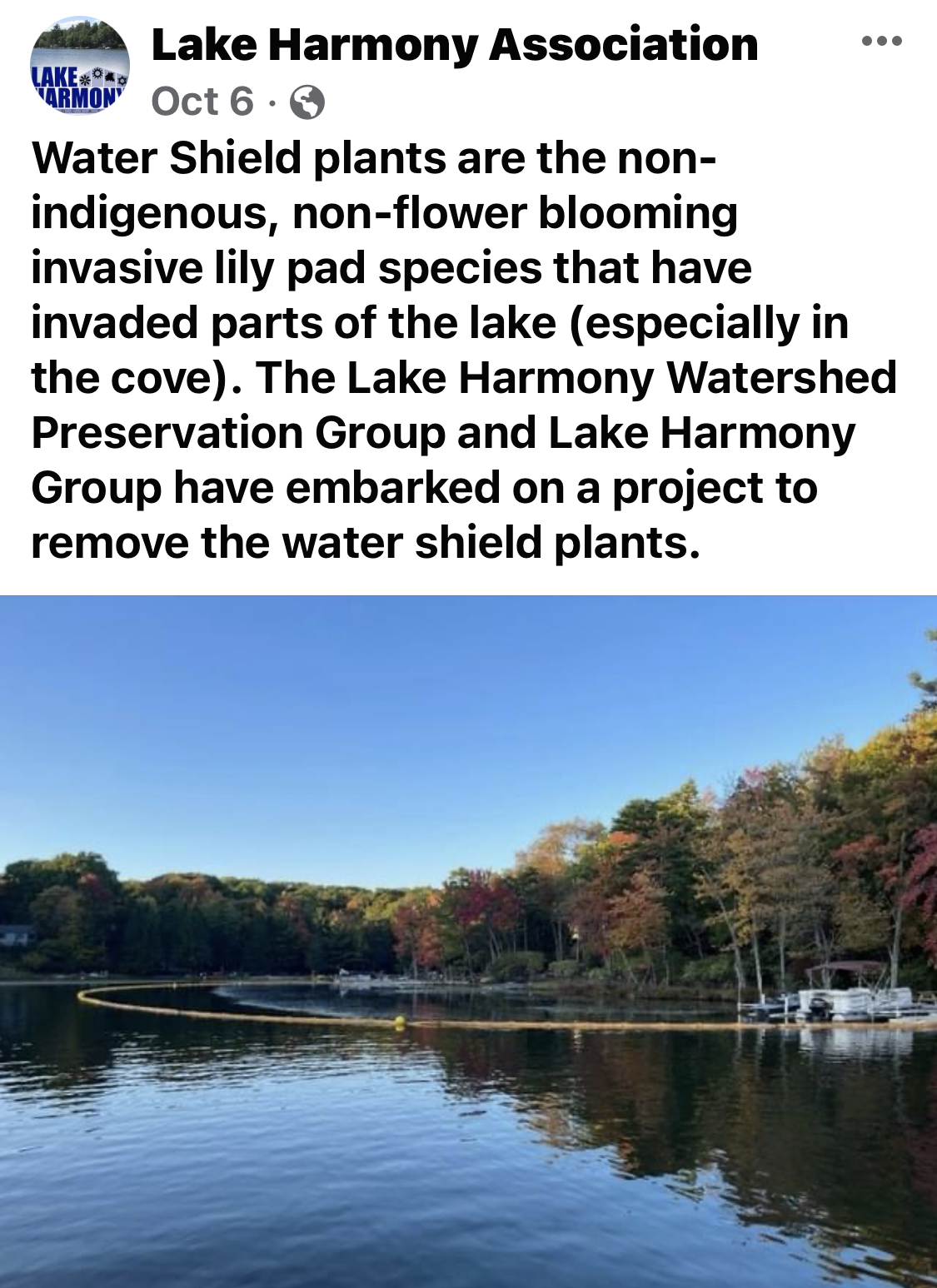
2022 Treatment Review
Natureworks Lake Harmony Survey 6.21.2022.pdf
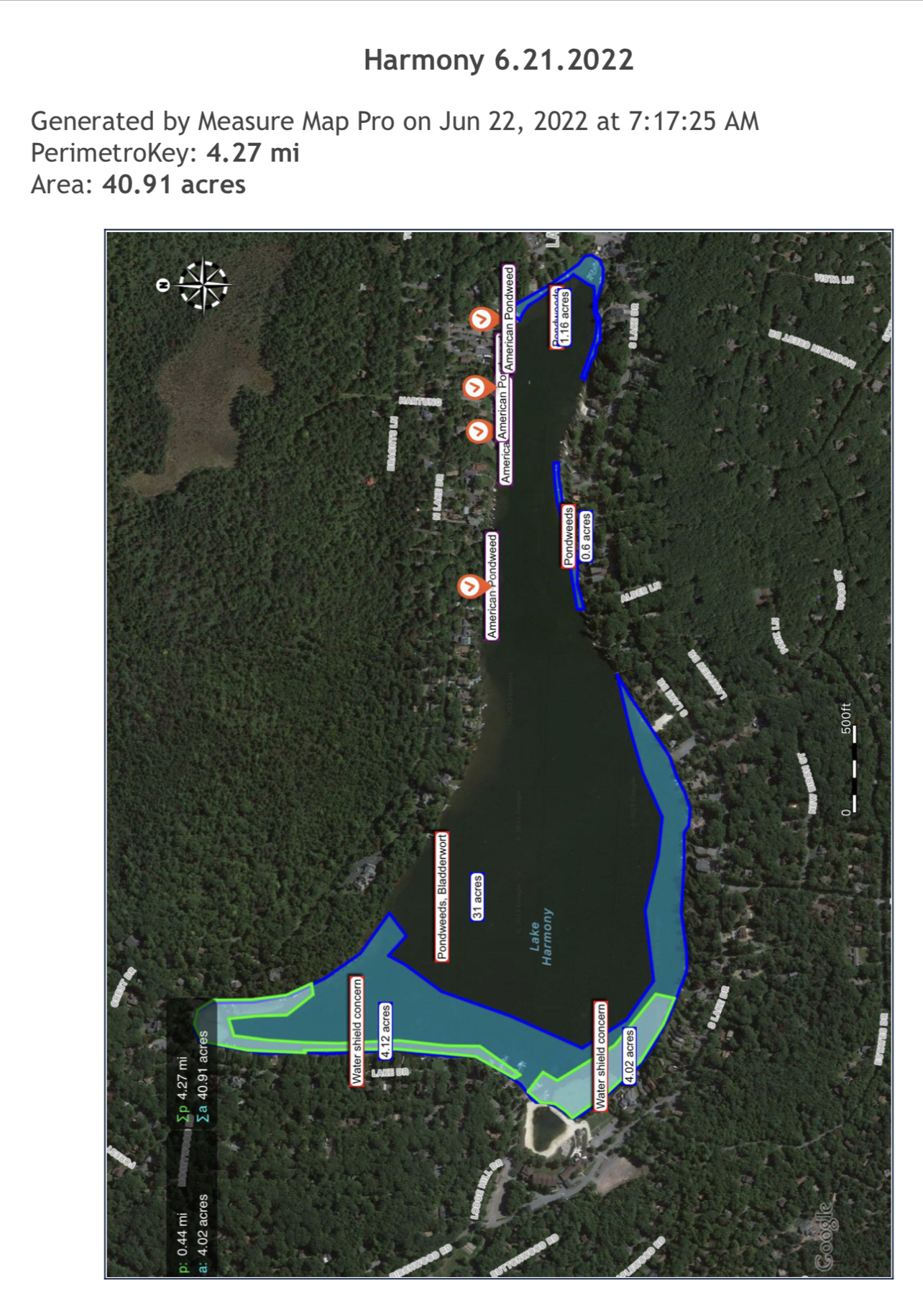
The Natureworks survey data and report from June 2022 is linked above. In 2022, the lake was treated five times. We had terrific compliance each time, thank you! Thank you everyone for discontinuing boating and lake activities until the following morning. About 20% of the lake area requires treatment each year.
The Natureworkds June 21, 2022 Survey summary email report provided stated that “Overall the lake looks good. Water quality testing results as well as clarity are very good. Plant growth is beginning along the shoreline in the shallow cove areas.” A map is provided in the survey report and also shown below. This map shows Pondweeds and Bladderwort growth in the Split Rock cove and American Pondweed toward the shoreline in the middle and end of the lake by Nicks Lake House.
To allow all species of weed growth to be up and ready for treatment, Natureworks stated they would be approximately four weeks out from June 21 to be ready for treatment. Treatment cannot be scheduled weeks or months in advance due to changing conditions within the lake as well as weather. Natureworks posts treatment notices as close to the week prior to treatment as possible.
Moving forward, discussions regarding additional floating weed management will be conducted and a plan will be discussed. Following previous treatments, floating boggs developed, so methods to address this in the future will be evaluated. Efforts to keep the upper end (Cove) of Split Rock clear were discussed.
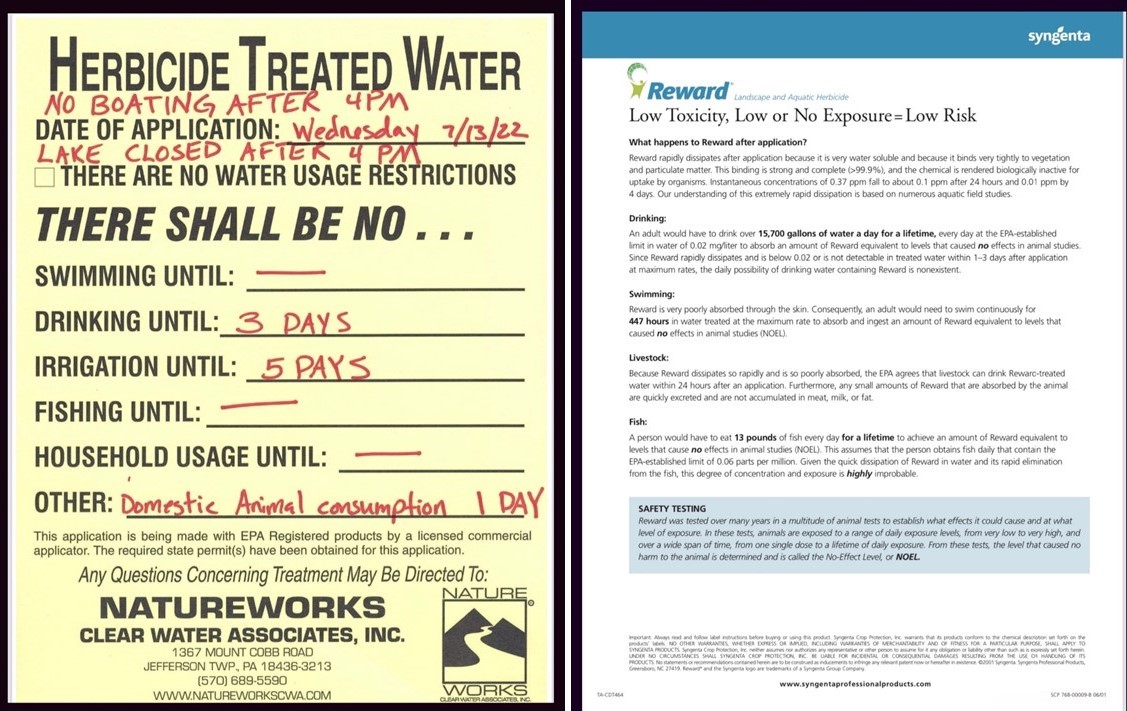
- When Natureworks employees treat Lake Harmony, they post their Herbicide Treatment Signs around the lake (shown below). Natureworks also provides a Fact Sheet about the treatment. Thank you for reviewing our Events and Important Messages.
Read more about Natureworks on their website: www.natureworkscwa.com.